Accountability Lab · Independent researchExperiment 001 · Approval patterns

The moment before action

Just before AI acts.

A human click does not automatically create human control. This exhibit explores what people need to see, decide and leave on the record before an AI action counts.

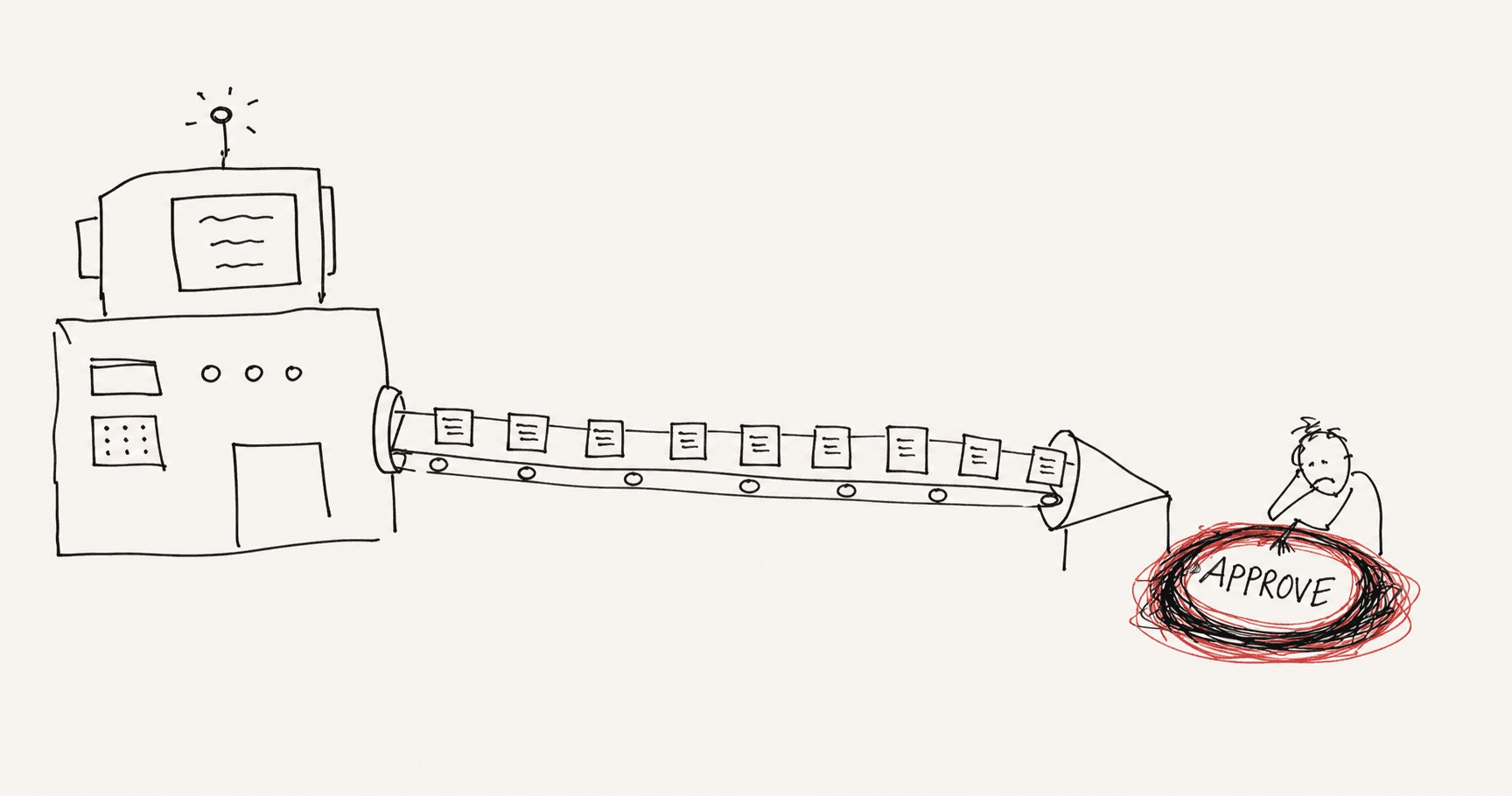
A crude drawing of a large machine funnelling many decisions toward a tired person with only one enormous approve button.
Action proposed · awaiting one click

Origin artefact · TX-1 Terminal Explorer

A useful loop. An unresolved question.

TX-1 explored an AI agent diagnosing a failed optimisation, validating a fix, and stopping before changing operational data. The gate worked—but it exposed a larger design problem.

What must a person know before an AI is allowed to change the world?

View the TX-1 origin project ↗
TX-1 / archived patternhuman gate: armed
01DiagnoseThe system identifies the operational constraint.
02Dry runThe proposed change is tested without committing it.
03ProposeThe smallest validated intervention is surfaced.
04DecideA human approves, edits, rejects or escalates.
05ActOnly the authorised change reaches the live system.
06RecordEvidence and ownership survive the moment.

01 · Calibrate the intervention

Autonomy is not binary.

The design question is not simply whether a human is in the loop. It is where, why and with what authority they enter it.

Selected autonomy · 03

Prepare

Draft the message, payment or configuration.

Oversight implicationMake the proposed action inspectable and editable.

02 · Equip the reviewer

The anatomy of a meaningful gate.

A decision surface should reduce uncertainty about the action—not merely move responsibility onto the nearest person.

Decision AP-2048meaningful gate

Release a supplier payment exception

£84,200 · bank details changed 48 hours ago · transfer is irreversible

03 · Pattern language

Eight ways to keep a person meaningfully in control.

Approval is only one mechanism. The right pattern depends on consequence, uncertainty, reversibility, volume and authority.

04 · Try the decision

Three proposals. No obviously safe answer.

These fictional workflows demonstrate the work of oversight: inspect the evidence, notice the limits, choose an action and see what remains on the record.

elevated consequenceSynthetic · Cedar & Tide

AI-prepared action

Issue a full £6,400 refund and waive the customer’s next invoice.

A major account experienced a twelve-hour service outage.

Evidence

  • Contractual service credit: 30%
  • Account value: £186k annually
  • Root cause confirmed
  • Customer has not requested cancellation

Uncertainty

Future churn risk is inferred from three previous cases.

Authority

Account directors may approve up to £5,000.

Reversibility

Credit can be cancelled before finance posts it at 17:00.

05 · Failure mode

Human-in-the-loop can still be approval theatre.

A visible human does not guarantee an informed, authorised or contestable decision. Compare the same moment designed two ways.

Weak gate

Approve recommendation?

Confidence 94% · generated 4 seconds ago

Interface diagnosis

  • No evidence snapshot
  • No visible alternative
  • Reject hidden in a menu
  • Reviewer authority unknown
The interface captures a click. It does not establish meaningful oversight.

06 · Regulatory horizon

Policy eventually lands in an interface.

Rules describe obligations such as oversight, traceability, accountability and redress. Product teams must decide what those obligations actually look like during work.

Important boundary

Educational design research only. This exhibit is not legal advice, a compliance assessment or a claim that any interface pattern guarantees compliance.

European UnionChecked 2026-07-11

EU AI Act — regulatory framework for AI

Human oversightActivity loggingTraceabilityDocumentationMonitoring

Questions for the interface

  • Can the assigned person actually exercise oversight?
  • Can a later reviewer reconstruct the action and its context?
Read the official source
United KingdomChecked 2026-07-11

Implementing the UK AI regulatory principles

TransparencyAccountability and governanceContestabilityRedress

Questions for the interface

  • Who owns the decision?
  • How can an affected person challenge or correct an outcome?
Read the official source
United States / voluntary frameworkChecked 2026-07-11

NIST AI Risk Management Framework

GovernMapMeasureManageHuman-AI roles

Questions for the interface

  • Are responsibilities differentiated and documented?
  • Does operational evidence improve the control over time?
Read the official source

07 · Work in public

This investigation is deliberately unfinished.

Accountability is not a component to ship once. These are the questions guiding the next experiments.

RQ-01

When does oversight become queue-clearing?

A gate can increase nominal control while reducing the attention given to each decision.

RQ-02

How should an interface reveal that a reviewer lacks authority?

Responsibility without authority produces accountability theatre.

RQ-03

What should replace the single confidence score?

Uncertainty, consequence and reversibility are different things and should not collapse into one number.

RQ-04

How do decision records learn from later outcomes?

Accountability must extend beyond the approval moment into monitoring and correction.